
AI Contact Centres for Councils: Connecting resident conversations to back-office action
A resident can explain a missed bin collection, a housing repair or a benefits query perfectly well to an AI assistant. But if that conversation ends in an email, a re-keying task or a note for somebody to pick up later, the council has only automated its front door.
For UK and Irish local authorities, the value of an AI contact centre is not the fluency of the conversation. It is whether that conversation can securely trigger, update and track real work inside the systems that actually deliver the service, the CRM, the LLPG, the telephony platform, the waste round, the FOI workflow, the in-cab device in a vehicle three miles away.
This article sets out how council digital and customer services leads can connect an AI contact centre to back-office systems, reduce avoidable contact, and do it without losing control of data, statutory deadlines or accessibility obligations.
KEY TAKEAWAYS
- 95% of responding English councils are already using or exploring AI, but most deployments stop at the conversation layer.
- Containment rate is the wrong success measure for a council. First-time resolution and avoidable contact reduction are the right ones.
- Integration should use documented APIs and supported connectors, never screen scraping.
- Agents need one search across every request, a live telephony screen pop, and a profile they can update once.
- Start with one or two high-volume, rules-based journeys where the back-office process is already well understood.
- Statutory decisions, FOI exemptions, safeguarding, eligibility, stay with officers. AI handles language; workflow handles control.
Why AI contact centres for councils need more than a clever front end
Local government contact centres sit at the junction between residents and dozens of operational services. A single interaction might need to identify an address, check an account, create a service request, route a case, schedule a visit, take a payment, retrieve an existing record and tell the resident what happens next. That is why an AI layer cannot be treated as a standalone chatbot project.
The pace of adoption is already accelerating. In its State of the Sector: Artificial Intelligence – 2025 update the Local Government Association reported that 95% of responding English councils were using or exploring AI, with generative AI the most commonly adopted form at 83%. The most commonly reported realised benefits were staff productivity (36%) and service efficiencies (33%), with cost savings some way behind at 21%.
That gap is the story. Councils are reporting productivity gains from AI, but far fewer are reporting money saved, because the administrative work behind the conversation has not gone anywhere. It has simply moved from the phone queue to somebody’s inbox. Those benefits become financially real only when AI can act on the council’s operational data and workflows rather than answering questions about them.
This also fits the direction of the Local Digital Declaration signed by more than 300 local authorities and supporting organisations, which promotes user-centred services, open standards and better use of data. The principle is straightforward: solve the resident’s whole problem, not just the conversational part of it. It is the same argument we made in council digital transformation and AI, the value sits in prevention and completion, not in deflection.
Where disconnected AI contact centres create friction
Consider a report of fly-tipping. The AI contact centre may understand the resident’s description perfectly and ask sensible follow-up questions. Yet the process still fails if an officer must copy the details into environmental services software, manually locate the site on a map and then separately notify the field team. The technology has reduced typing for the resident while preserving almost all of the internal administration, and it has added a new integration point to maintain.
The pattern repeats across the highest-volume council journeys:
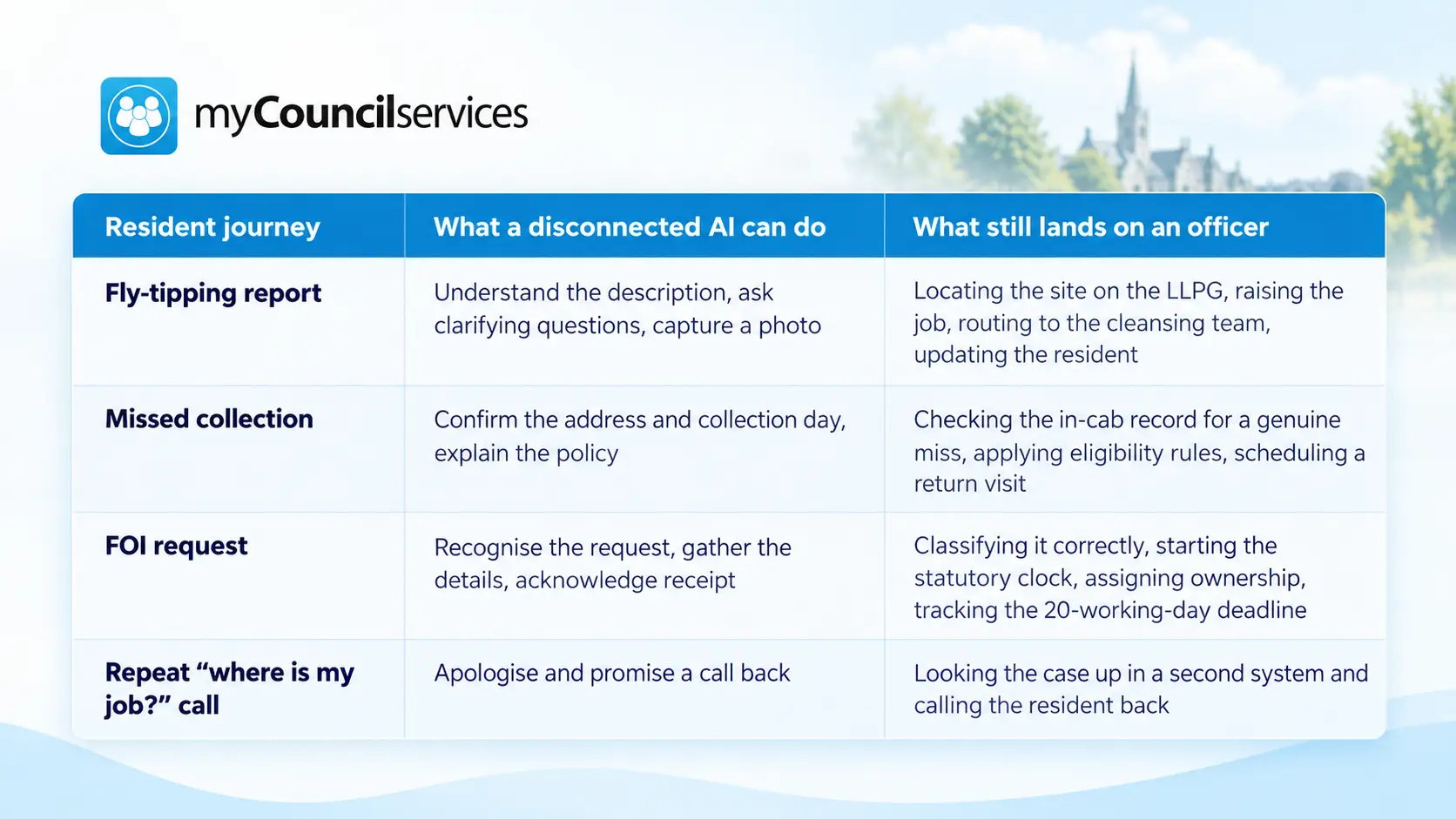
In each case, the resident’s experience improves slightly, and the council’s cost base does not move. Worse, the council now has a confident-sounding front end making promises the back office has no visibility of.
The integration model: conversation, orchestration, and systems of record
A useful architecture separates three responsibilities. The AI contact centre handles natural-language interaction. An orchestration layer applies rules, permissions and workflow logic. Existing back-office applications remain the authoritative systems of record. This keeps actions controlled, reversible and traceable, which is what an auditor, an SIRO and a scrutiny committee will each ask about.
1. Start with a governed service catalogue
The AI should know exactly what it is allowed to do for each service. It may provide information, collect structured details, create a case or, in a tightly controlled workflow, check status or initiate an appointment request. Required data, validation rules, and human escalation points should be defined in advance, service by service, and reviewed as part of change control, not inferred by the model at runtime.
2. Use APIs and structured interfaces, not screen scraping
Reliable integration should use documented APIs, web services, or supported connectors. Structured interfaces give IT teams clearer security controls, rate limiting, and monitoring than screen scraping, and they are far less fragile when a supplier changes a user interface. Screen scraping also tends to require broad credentials, which is the opposite of least privilege.
With MCS, a practical starting point is the self-service CRM and service desk. Its role is to maintain a consistent case history while connecting resident contact to workflow, service requests and back-office teams, so the AI has one place to read from and write to, rather than a dozen point integrations.
3. Make context portable across channels
A resident may begin in webchat, continue by telephone and later check progress online. The case context should move with them. The GOV.UK Service Standard calls for a joined-up experience across channels; forcing residents to repeat the same story because context did not follow the interaction damages confidence quickly, and it generates exactly the avoidable contact the programme was meant to remove.
Connecting AI contact centres to core council services
CRM and case management
The CRM is usually the natural coordination layer. An authenticated or appropriately verified interaction can search for an existing case, create a new request, append notes, set a priority, assign a team, and return a reference number. That single capability is what turns an AI contact centre from an information channel into a service channel, and it is what makes local authority CRM integration the first item on any sensible roadmap.
GIS, addresses and the LLPG
Location-sensitive services depend on resolving a conversational description to an authoritative record. GIS and LLPG mapping is particularly valuable for highways, environmental, planning and public-realm interactions.
That allows a resident’s description, “the lamp outside the library”, “rubbish beside the footpath”, to be resolved against an authoritative address, street, parcel or asset record before a job is created. Better location data means fewer duplicate reports, fewer misrouted tasks and less officer time spent clarifying where the problem actually is. For highways, housing and roads in particular, accurate asset matching is the difference between a job and a follow-up call.
Waste and environmental services
Waste is the highest-volume contact driver in most district and unitary councils, which makes it the obvious first integration. MCS Waste & Environmental Services can support processes such as missed collections, container requests, bulky waste, street cleansing or environmental reports. The AI gathers the required information conversationally, while the back-office workflow determines eligibility, routing, schedules and fulfilment, so the answer the resident gets is the one the round can actually honour.
Information rights and complaints (FOI, SAR and EIR)
Requests that may fall under information-rights legislation need especially careful classification and governance, because a misclassified request is a missed statutory deadline. MCS Complaints (FOI/SAR/EIR) ensures the request enters the appropriate workflow with deadlines, ownership, correspondence and a complete audit trail from first contact onwards. AI can assist with triage and drafting, but statutory decisions, exemptions and disclosure controls must remain subject to appropriate human oversight.
Bookings and appointments
A large share of contact is a scheduling problem in disguise: a bulky waste slot, a registrar appointment, a housing visit, a recycling centre booking. Connecting the conversation to bookings and appointments lets the AI offer a real slot against live availability rather than promising a call back. This is usually the fastest measurable reduction in avoidable contact available to a council.
Revenues and benefits
Revenues and benefits generates high-anxiety, high-repeat contact, and it is where governance matters most. Integration with revenues and benefits can allow verified residents to check status, report a change of circumstances or set up an arrangement, while decisions on liability, entitlement and recovery remain with officers. Read-only status checks alone remove a substantial volume of repeat calls.
Field and mobile working
The final step is usually outside the office. Mobile working and in-cab solutions mean a contact-centre interaction can become a task for an inspector, operative or officer without duplicate entry, and status updates can flow back to the resident-facing channel, closing the loop. Without this last hop, every other integration still ends in a phone call to a depot.
The agent’s side: one search, live telephony and conversation intelligence
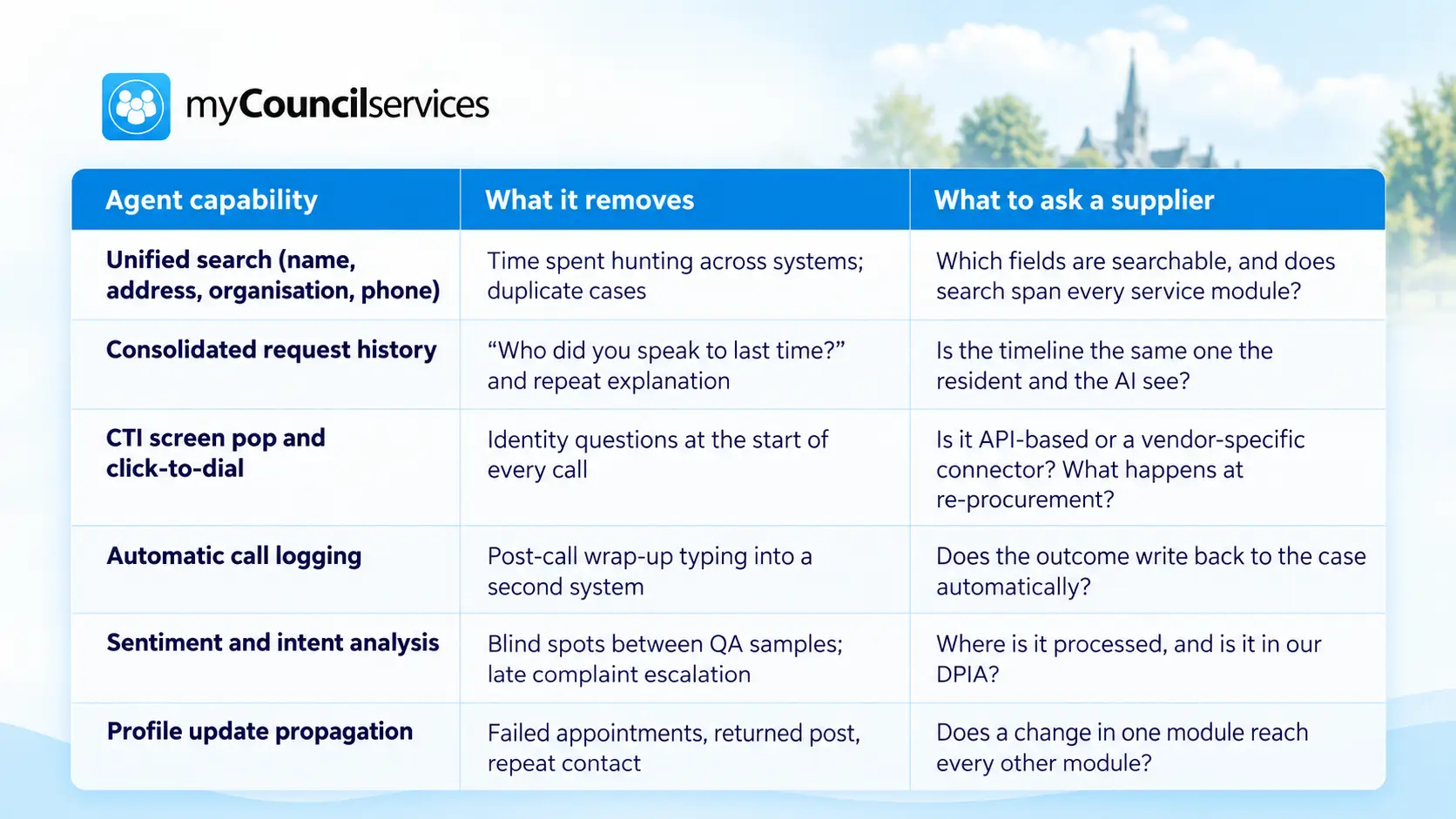
Most writing about AI contact centres focuses on the resident. In a council, the harder problem is usually the agent’s screen. An advisor taking a call about a housing repair should not need four systems, three logins and a sticky note with a reference number on it. Automation removes some contact; giving the agent a complete picture removes far more handling time from the contact that remains.
One search across every request, by name, address, organisation or phone number
Residents do not know their case reference. They know their name, their street, and sometimes the name of the housing association or business they are calling about. A council contact centre therefore needs a single search that resolves any of those into one record: search by resident name, by property or UPRN, by organisation, by telephone number, by email address or by reference, and return every request associated with it.
That matters more than it sounds. A resident who has reported a missed collection, chased it, then raised a complaint about the chase is one person with three cases in three service areas. If the agent sees three unrelated tickets, they will apologise and create a fourth. If they see one timeline, they can resolve all three in a single call and close the loop. This is what councils usually mean by a single view of the resident, and it is the difference between a case management system and a contact centre platform.
In MCS, the self-service CRM and service desk holds that consolidated contact history across every service module, waste, highways, licensing, revenues, information rights, so the timeline an agent sees is the same timeline the AI reads before it answers, and the same one the resident sees online.
Telephony and CTI integration: 8×8, Mitel and others
Telephony is where most council contact centre integrations quietly fail. If the phone system and the CRM do not talk to each other, every call starts with the agent asking for details the switchboard already has, and ends with the agent typing a summary into a second system.
Computer telephony integration (CTI) closes that gap. Practically, it should deliver four things:
- Screen pop on answer — the caller’s number is matched against the CRM and the resident’s record, open cases and history appear before the agent says hello.
- Click-to-dial from the case — outbound calls placed from the record, so they are attributable without anyone re-keying a number.
- Automatic call logging — duration, outcome, agent, and any recording reference written back against the case, not stored in a separate telephony report nobody reads.
- Intelligent routing — known vulnerable residents, repeat callers or open-complaint cases routed to the right queue or a named officer rather than the general line.
Councils run a wide mix of platforms, 8×8, Mitel, Microsoft Teams Phone, Cisco, Avaya, Genesys, Amazon Connect, often inherited through different procurement cycles, and increasingly reviewed as part of reorganisation. The right question to ask a supplier is not “do you integrate with 8×8?” but “how do you integrate, and what happens when we change platform?” An integration built on documented APIs and open CTI standards survives a telephony re-procurement. One built on a bespoke connector to a single vendor becomes a reason not to change phone systems, which is a poor position for a council to negotiate from.
Worth checking early: whether call recordings and transcripts are retained inside the telephony platform, inside the CRM, or both, and which retention schedule applies. Duplicated recordings across two systems is one of the more common findings in a council information governance review.
Sentiment analysis and conversation intelligence
Once conversations are captured as structured text, AI can read them at a scale no quality team can match. Most councils sample perhaps one or two per cent of contacts for quality assurance. Automated sentiment and intent analysis can review all of them.
The useful applications in local government are specific:
- Escalation before complaint — detecting rising frustration across a sequence of contacts, so a case is reviewed before it becomes a formal complaint or an Ombudsman referral.
- Vulnerability and safeguarding signals — flagging language that suggests a resident may need additional support, additional time, or a referral to another team.
- Demand intelligence — clustering what residents are actually contacting about, which surfaces the failing process behind a spike far faster than a monthly volume report.
- Quality assurance at scale — consistency of advice, adherence to policy and tone across the whole contact centre rather than a small sample.
- Channel and content gaps — identifying the questions the website answers badly, which is usually the cheapest avoidable contact to remove.
Two cautions belong in the business case. First, sentiment scoring of residents is a processing activity that needs to appear in your DPIA and your privacy notice, and any vulnerability marker is likely to be special category or otherwise sensitive personal data with its own retention and access controls. Second, sentiment should inform a human decision, not make one. A model’s reading of tone is a prompt for an officer to look, not a determination about a resident, and it should never on its own change someone’s priority, entitlement or service level.
Where sentiment analysis genuinely earns its place is alongside FOI, SAR and EIR complaints handling, where early identification of a dissatisfied resident is measurably cheaper than a statutory complaint investigation.
Keeping the resident profile current
Every contact is an opportunity to correct the record, and most councils waste it. If an agent, or the AI, with the resident’s confirmation, can update a telephone number, an email address, a correspondence address, an accessibility or communication preference, a consent flag or a support requirement during the call, that correction should propagate to every service that uses it rather than sitting in one module.
The practical test is simple: if a resident tells your waste team their new phone number, does the housing team have it? In most councils, the answer is no, and the cost of that appears as failed appointments, returned post, missed collections and repeat contact. Master data management across service modules is unglamorous, but it removes more avoidable contact than most AI features do.
Profile updates initiated through an AI channel need the same controls as any other write: verified identity for anything that affects correspondence or payment, a full audit trail of what changed and who confirmed it, and read-only defaults for anything with financial or statutory consequence.
Security, privacy and accessibility cannot be bolted on later
The LGA’s 2025 survey illustrates why this matters: 83% of respondents identified cyber security as a great or moderate AI risk, while 68% highlighted organisational reputation and resident trust. These are not reasons to avoid AI. They are reasons to design controls into the service from the outset.
Cloud-based, secure and scalable architecture supports consistent identity controls and changing demand, but cloud hosting is not a substitute for governance. Integration permissions should follow least-privilege principles, with deterministic validation or human approval for high-impact actions: anything that moves money, changes entitlement, or starts a statutory clock.
Accessibility deserves the same treatment. Public sector digital services in scope must meet WCAG 2.2 AA and the GOV.UK Design System provides tested accessible patterns. AI interfaces still need clear labels, keyboard operability, understandable errors, accessible authentication and an obvious route to assisted service. An AI channel that a screen reader user cannot complete is not a channel; it is a barrier with a new name.
The assurance questions to ask any AI contact centre supplier
Before a business case reaches committee, information governance will ask most of these. Getting the answers early shortens the process considerably:
- Where is resident data processed and stored, and does any of it leave the UK or EEA?
- Is resident data, including call transcripts, used to train the supplier’s models, and can that be contractually excluded?
- Does the supplier hold Cyber Essentials Plus and ISO 27001, and when were they last assessed?
- What penetration testing cadence applies, and will the supplier share the summary report?
- Can the supplier provide DPIA input, records of processing, and clear controller/processor definitions, including for sentiment analysis and vulnerability flags?
- Is there a published accessibility statement, and has the interface been tested against WCAG 2.2 AA with assistive technology?
- Which integration permissions does the AI hold, can they be scoped per service, and is every action logged and attributable?
- How is the telephony integration built, and what is the migration path if we change phone system?
- What happens on failure, does the resident reach a human, and does the case still get created?
Measure outcomes, not call deflection
It is tempting to judge an AI contact centre by containment rate: how many interactions did not reach a human agent? For councils, that metric is actively misleading. A conversation that ends without human contact but leaves the resident’s problem unresolved is not a success; it is a repeat contact scheduled for next week, and often a complaint after that.
A better framework follows the service outcome. This is also the difference between genuine channel shift and simply moving the queue:
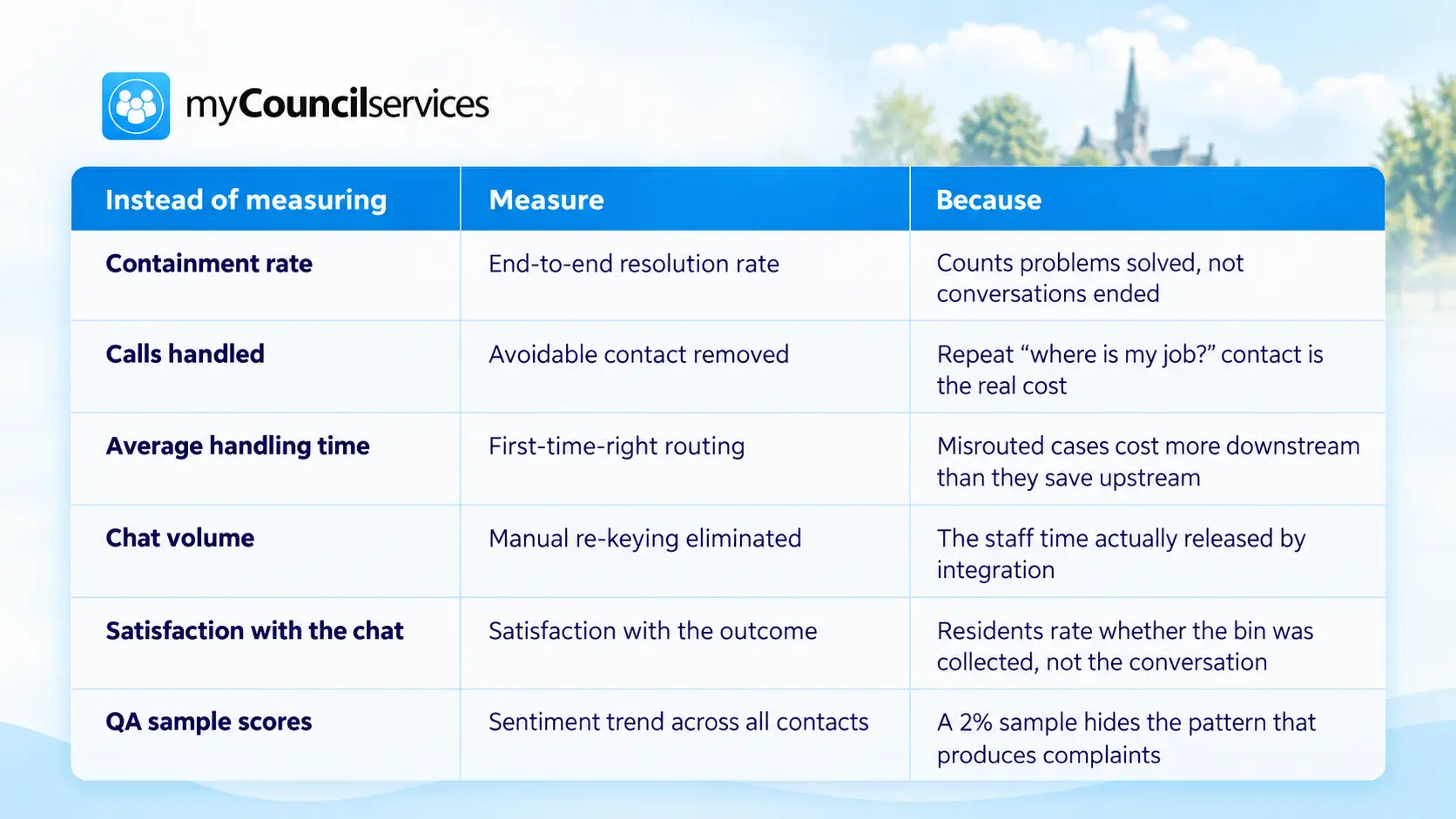
These measures align far more closely with the Service Standard, and they are the ones that survive contact with a scrutiny committee.
What local government reorganisation means for contact centre AI
For many English councils, the immediate context is not AI at all, it is local government reorganisation. Merging authorities inherit multiple contact centres, multiple CRMs, multiple telephony contracts and multiple sets of service rules, and the temptation is to defer AI until the estate settles.
That is usually the wrong sequence. An orchestration layer that sits between channels and systems of record is exactly what makes a multi-authority estate manageable: it lets a single resident-facing channel route to different back-office systems during transition, and it makes the eventual consolidation a change of destination rather than a change of channel. Councils that build the integration layer first tend to find that reorganisation shortens rather than lengthens their AI roadmap.
A practical route from pilot to production
Councils do not need to connect every service before they gain value. A controlled rollout is safer, cheaper and much easier to evaluate, and it produces the evidence a business case needs.
- Choose one or two high-volume, rules-based journeys where the back-office process is already well understood. Missed collections and bulky waste bookings are common starting points.
- Map the complete resident journey, including identity, data capture, system updates, exceptions, and human escalation.
- Define the authoritative source for each data item, and expose only the API operations the AI-enabled workflow genuinely needs.
- Connect the telephony and CRM layers early, screen pop and unified search deliver measurable handling-time savings before any automation goes live.
- Test with real service scenarios, ambiguous language, accessibility needs, failed integrations, and the unusual edge cases your officers already know about.
- Measure end-to-end resolution, accuracy, staff effort, and resident outcomes before expanding to further services.
This sequencing sits inside the wider picture we set out in our local authority digital strategy guide.
Ireland: aligning with the Digital Public Services Plan 2030
For Irish local authorities, the driver is explicit. Ireland’s Digital Public Services Plan 2030 sets targets for 100% of key public services to be available online and 90% of applicable services to be consumed digitally by 2030. Meeting a consumption target, not just an availability target, requires services residents can complete end to end. Integrated AI should support that wider service architecture, not sit alongside it as a separate channel with its own data.
Where My Council Services fits
My Council Services is a cloud-based council management platform spanning resident self-service, CRM, workflow, specialist service modules and mobile working. It has been built for UK and Irish local government since 2012, is used by more than 50 local authorities including Test Valley Borough Council, Torfaen County Borough Council and Swale Borough Council, and its resident-facing interfaces follow the GOV.UK Design System. Read our customer stories.
The important point is not producing a fluent AI answer. It is connecting that answer to a controlled operational action, in a system that already holds the council’s service rules, the resident’s full contact history and the profile every other service depends on.
For a council digital lead, the target architecture is therefore less about replacing every existing application and more about creating a dependable service layer between channels and systems. AI handles language. Rules and workflow handle control. Back-office systems retain authoritative records. Staff stay involved wherever judgement, safeguarding, statutory interpretation or exception handling requires them.
Get those boundaries right and an AI contact centre can cut avoidable administration while giving residents a more coherent experience across phone, web and self-service. More importantly, it can help the council complete the work behind the conversation.
Frequently asked questions
What is an AI contact centre for a council?
An AI contact centre uses conversational AI to handle resident enquiries across phone, webchat and messaging. For a local authority, the defining feature is not the conversation but the integration: whether the AI can create and update cases in the council’s CRM, telephony, waste, mapping and mobile working systems rather than generating an email for an officer.
Can an AI contact centre integrate with our existing phone system?
Yes. Councils commonly integrate platforms such as 8×8, Mitel, Microsoft Teams Phone, Cisco, Avaya, Genesys and Amazon Connect. What matters is how: an API-based CTI integration delivers screen pop, click-to-dial and automatic call logging while remaining portable if the council re-procures its telephony. A bespoke single-vendor connector does not.
Can agents search for a resident by name, address or phone number?
They should be able to. A council contact centre platform needs one search that resolves a name, property or UPRN, organisation, telephone number, email address or case reference into a single consolidated view of every request that resident has raised, across every service area.
Can AI detect an unhappy or vulnerable resident?
Sentiment and intent analysis can flag rising frustration, distress, or language suggesting a resident needs additional support, across every contact rather than a QA sample. It should prompt an officer to look, never make a determination on its own. Sentiment scoring and vulnerability markers must appear in your DPIA and privacy notice, with defined retention and access controls.
Does an AI contact centre replace the council’s CRM?
No. The CRM remains the system of record and the coordination layer. The AI is a channel into it. Replacing the CRM to add AI is almost always the more expensive and riskier path.
How much avoidable contact can a council realistically remove?
It depends entirely on which journeys are integrated. The largest reductions typically come from status enquiries and appointment booking, where a resident calls because they cannot see progress. Councils should baseline repeat contact per case before the pilot, or the saving cannot be evidenced.
Is resident data safe with AI contact centre software?
That depends on the supplier’s contract and architecture, not on AI as a technology. Establish where data is processed, whether transcripts are used for model training, what certifications the supplier holds, and whether every AI-initiated action is logged and attributable.
Does AI-powered self-service have to meet WCAG 2.2 AA?
Public sector websites and mobile apps in scope of the accessibility regulations must meet the applicable standard, and an AI interface is not exempt. It needs clear labels, keyboard operability, understandable error messages, accessible authentication and an assisted-service route.
Where should a council start?
With one high-volume, rules-based journey where the back-office process is already well documented, usually missed collections, bulky waste or a booking service, and with the telephony and CRM integration that shortens every call. Prove end-to-end resolution, measure it properly, then expand.
See what integrated looks like
My Council Services connects resident conversations to the systems that deliver the service, CRM, telephony, mapping, waste, information rights and mobile working, on one configurable platform built for UK and Irish local government.
No procurement commitment. We can start with a single service journey.
Further reading:
- Council online forms software: Moving beyond PDFs
- Council Committee Management Software for UK and Irish Local Authorities
- AI-powered mobile workforce & self-service kiosk solutions for local authorities
- The missing tech stack in UK social housing: Why legacy systems are fueling the accommodation crisis