
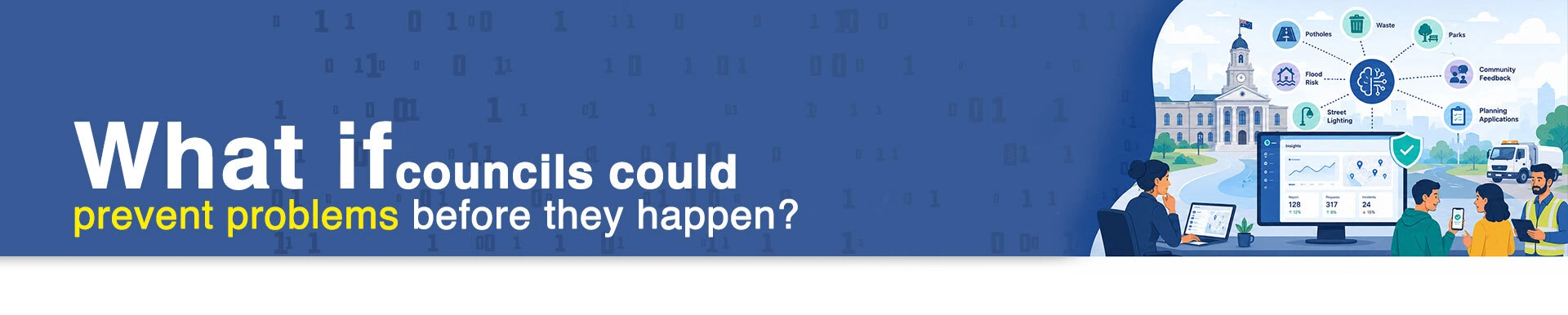
Council digital transformation and AI: Moving from crisis response to prevention
Most council officers could tell you, with some precision, exactly where the pressure is going to come from next week. The housing team already knows which cases are heading towards statutory homelessness. The complaints manager can name the services generating repeat contacts. The revenue team knows which residents are falling behind. The problem isn’t knowledge; it’s that the tools and systems most councils are working with weren’t built to act on that knowledge early enough.
Council digital transformation, when it’s done properly, is the practical answer to that problem. It gives officers earlier visibility, cleaner data and faster routes between identifying a problem and doing something about it. And as artificial intelligence begins to earn a serious place in local government planning, it offers a way to sharpen that capacity further, provided the right foundations are already in place.
That last point is the crux of this article. AI is not the transformation. It’s the amplifier. What it amplifies, clean data and joined-up systems, or fragmented processes and outdated records, depends entirely on the decisions councils make before the first algorithm runs.
The gap between knowing and acting
There is a particular kind of institutional frustration that builds when an organisation can see a problem forming but can’t reach it in time. It happens in councils more than most places, because the nature of local government means different services, housing, environmental health, waste, licensing, customer services, often hold different pieces of the same resident’s story without ever comparing notes.
A resident contacts the council four times in three months. The first call goes to the contact centre. The second raises an environmental issue. The third is a housing query. The fourth is a formal complaint. To each team, it looks like a separate, manageable case. To anyone looking across all four, it’s a household in difficulty that needed coordinated help much earlier. This is not a failure of effort; it’s a failure of visibility, and it’s precisely what MHCLG’s Future Councils pilot, which worked closely with eight councils over several months, identified as one of the most common blockers to effective local services: a disjointed view of residents, especially the most vulnerable, that prevents early intervention and drives up long-term costs.
Fixing that visibility gap is not a technology project in itself. It’s a service design question: how should information flow between teams, and what needs to happen automatically versus manually? Technology then makes the answer to that question operational. Without answering it first, no platform, however sophisticated, closes the gap.
The financial case for acting earlier
The broader funding picture makes earlier intervention not just desirable but operationally necessary. According to the Local Government Association, English councils face a combined funding gap of £6.2 billion across 2025/26 and 2026/27, simply to maintain services at their current, already reduced levels, with that gap projected to widen to £8.4 billion by 2028/29. At the same time, the LGA has found that more than nine in ten councils are struggling to fill essential roles, meaning workforce capacity cannot be the answer to rising demand.
Every case that escalates unnecessarily, from an enquiry to a complaint, from a complaint to an ombudsman referral, from early housing concern to full homelessness application, costs more to resolve than it would have cost to prevent. Demand management through earlier, better-informed intervention is one of the few strategies that simultaneously improves resident outcomes and reduces unit costs. Digital tools that enable it are not a budget line item in the traditional sense; they are the mechanism through which those savings become achievable.
This thinking is now embedded in central government policy. GDS Local, the new Government Digital Service team launched specifically to support local authorities, has been explicit that its aim is to help councils build shared digital infrastructure, components designed once and reused widely, rather than every authority solving the same problems independently at greater cost. The ambition, as the team put it, is a joined-up government where digital infrastructure is shared, services are interoperable, and residents experience services that work for them.
What prevention actually requires from digital systems
Prevention is only achievable when the right information is available to the right person at the right moment. That sounds straightforward; in practice, it requires several things working together that frequently don’t.
The first is data quality at the point of collection. A resident submitting a service request through a structured, well-designed digital form generates clean, categorised, searchable data from the outset. The same resident describing the same issue over the phone, whose call gets noted in shorthand and re-keyed hours later into a separate system, generates something far less useful. The difference compounds over thousands of interactions. Good online forms and self-service tools aren’t simply about resident convenience, they’re about the quality of the operational picture that accumulates behind them.
The second is connectivity between systems. A CRM that links a new case to everything the council already holds about that resident, previous contacts, open cases, payment history, prior service requests, gives the receiving officer a context in seconds that would otherwise take twenty minutes of calls to reconstruct. Case management that connects intake to triage to allocation to resolution, with automated flags where cases sit untouched past defined thresholds, turns oversight from a manual task into something the system does continuously.
The third is data governance serious enough to make the first two sustainable. Research from Heriot-Watt University assessing AI readiness across 208 UK councils found that readiness for AI, and by extension, for data-driven service improvement, is not determined by council size or budget. It is determined by leadership ambition, governance discipline and the underlying quality of data foundations. Councils that had invested in getting those basics right were pulling ahead; those held back were most often dealing with legacy system fragmentation, not a lack of appetite for change.
Where AI genuinely helps, and where it doesn’t
AI has arrived in local government budgets faster than most councils had planned for. Freedom of Information disclosures to major UK city councils show consistent year-on-year growth in AI-related spending, particularly across workflow automation, predictive analytics and resident-facing services. The national direction is clear: MHCLG’s Local AI initiative was set up precisely to help councils navigate that growth with more structure and confidence, treating AI capability as something to be built collectively across local government rather than reinvented separately by each authority.
The practical cases are building up. Surrey County Council has been trialling AI-enabled defect detection to help highways teams identify road issues faster than traditional inspection cycles allow. Planning authorities in England are piloting AI tools that triage routine householder applications, summarise documentation and give officers an initial assessment, with the aim of roughly halving processing time on the high-volume, lower-complexity cases that dominate most planning teams’ workload. In each example, the structure is consistent: AI handles the volume and pattern recognition; the officer retains judgement and accountability.
The cases where AI adds less value follow an equally consistent pattern: fragmented input data, unclear ownership of outputs and no human review process built in. A summarisation tool applied to poorly structured case records produces confident-sounding but unreliable summaries. A predictive model trained on incomplete demand data identifies patterns in the gaps as readily as patterns in the facts. Putting AI on top of a broken process does not improve the process; it accelerates the consequences of it.
There is also a governance risk specific to the current moment. Local government reorganisation, with substantial consolidation into larger unitary authorities underway across England, creates conditions where AI-assisted document summarisation can quietly distort institutional memory. Committee minutes, planning histories, contested policy decisions: when these are condensed by an algorithm during a merger process, the nuance that made them significant can disappear. Practical guidance from the sector is clear that LGR should be treated as an opportunity to embed better data practices and governance into new structures, not a moment to rush AI adoption without the oversight frameworks to support it.
Coordinating services across a complex landscape
One of the less-discussed dimensions of council digital transformation is how much of modern local service delivery depends on coordination rather than direct delivery. A response to rough sleeping draws in housing, social care, voluntary sector partners, NHS outreach and private landlords. An environmental enforcement case may involve the council, a contractor, a licensed waste carrier and a statutory reporting obligation. A planning application touches highways, ecology, heritage and multiple internal departments before a decision is issued.
That coordination work is genuinely difficult to do well with email threads, shared inboxes and spreadsheets. What makes it manageable at scale is case management with role-based access controls, clear audit trails and structured workflows that route information to the right place without depending on an officer to manually copy it. A contractor updates a job status through a portal rather than a phone call. A voluntary sector partner sees what they need to see about a shared case without accessing unrelated council data. An officer preparing a statutory report pulls from a live case record rather than chasing individual teams for updates.
AI can assist this coordination layer, helping draft notifications, summarising case histories for incoming officers, flagging cases where multiple services are involved without a nominated lead. The value is real. But it is conditional on the underlying case management and data architecture being sound enough to make AI summaries trustworthy rather than convenient fictions.
Configuration over rigidity: why one size has never fitted all
The structural diversity of UK local government is not a problem to be engineered around; it’s a design constraint that any serious platform has to accommodate. A coastal district authority’s environmental workload looks nothing like a metropolitan borough’s. A Welsh unitary authority operates under different statutory reporting requirements than a Midlands district council. An Irish local authority manages housing allocations under different legislation entirely from its counterpart in England. And all of them have operational quirks shaped by local geography, political priorities and the particular history of how services evolved in their area.
The challenge this creates for digital transformation is that off-the-shelf platforms designed around a generic council template tend to get worked around rather than worked with. Shadow spreadsheets reappear. Teams build workarounds that the platform wasn’t designed for. The gap between what the system thinks is happening and what is actually happening widens quietly until someone notices. MHCLG’s Future Councils research identified this as one of the systemic barriers that individually affects council after council: underutilised technology solutions that fail to fit actual workflows, increasing delivery costs and fragmenting the very resident journeys they were supposed to improve.
Configurable infrastructure, where workflows, forms, SLAs, notification rules and reporting can be adjusted to match how a council actually operates, without each change requiring a developer project, changes the relationship between the system and the organisation. Teams use what works for them rather than adapting to what the system allows. That’s a practical matter, not a theoretical one: adoption rates, data quality and long-term value are all higher when the system fits the work.
Releasing capacity through automation
The workforce constraint in local government is not going to ease in the near term. With nine in ten councils struggling to fill essential roles and recruitment gaps widening between local government and other sectors, the available answer isn’t more headcount. It’s ensuring that the headcount in place is spending its time on work that genuinely requires human judgement rather than tasks that are administrative in nature and repeatable by design.
The practical gains from automating the right things are cumulative and meaningful. A mobile working solution that lets a housing officer log an inspection once, from a tablet in the field, and have that data flow directly into the case record without a re-keying step later, saves a small amount of time per inspection. Across three hundred inspections a month, that becomes significant recovered capacity. Automated case notifications, letting residents know where their request is without them having to ring and ask, reduce inbound contact volume without any reduction in service quality. Automated escalation flags when cases sit idle past a threshold prevent the quiet accumulation of risk that turns a manageable caseload into a complaints surge.
AI extends this further in specific areas. Tools being piloted across English planning authorities are converting decades of handwritten and paper-based historical records into searchable digital data at a pace that manual transcription could never match, directly supporting the data quality improvements that better services depend on. In customer services, AI-assisted triage can route contacts to the right team at first touch rather than after several transfers, with measurable impact on both resolution time and resident satisfaction.
What prevention-led digital transformation looks like in practice
Across the service areas where councils have built out prevention-focused digital approaches, a common set of capabilities tends to underpin the results:
- Structured online reporting for issues like fly-tipping, antisocial behaviour and highway defects, capturing clean, location-tagged, categorised data that flows directly into operational queues rather than officer inboxes
- Self-service CRM portals that give residents visibility of their case status, reducing the avoidable contact that ties up front-line teams
- Booking systems that shift routine, high-volume transactions, waste collections, registrar appointments, environmental health visits, facility hire, away from phone and email, freeing officer time for complex casework
- Mobile inspection and mobile working tools that update central records in real time, giving managers live operational visibility rather than end-of-day summaries
- Case management for FOI, SAR and EIR requests with automated deadline tracking, so statutory obligations are met consistently regardless of team workload at any given moment
- Reporting dashboards that surface demand patterns, which wards are generating rising contact volumes, which service types are seeing seasonal spikes, early enough to adjust capacity before pressure peaks
- AI-assisted drafting support for high-volume correspondence and statutory documentation, with officers reviewing and approving every output before it is used
- Partner and contractor access portals that give external parties the visibility they need to update case progress without creating data protection exposure
None of these capabilities transforms a council on its own. Together, across a connected platform, they shift the operational posture from reactive management to something closer to proactive stewardship of service demand.
Honest about what this isn’t
Council digital transformation is sometimes described as if the main challenge is making the case for it. Most councils at this point don’t need convincing. What they need is clarity about where to start, what the realistic sequence of change looks like and what failure modes to watch for.
The most common one is mistaking digitisation for transformation. Putting a form online that used to be a phone call is useful. It is not transformative if the form submission drops into an officer’s inbox to be manually re-keyed into a separate system and chased by hand. The test is whether the digital intervention has changed how work flows through the organisation, not just how it arrives.
The second is treating AI as a shortcut past foundational work. Councils that have achieved real value from AI tools share a common characteristic: they had already invested in data quality, workflow connectivity and governance before they introduced AI into those environments. Councils that have been disappointed by AI pilots share a different characteristic: they expected AI to compensate for the fragmentation those pilots were introduced into.
The third is underestimating the governance requirement. WCAG accessibility compliance, UK GDPR data handling, audit trails for case decisions, role-based access controls, alignment with the Local Digital Declaration and the Digital Service Standard, these are not optional additions. They are the conditions under which digital public services earn and retain public trust, and they need to be built in rather than bolted on.
Building services that are ready for what comes next
The pace of change in local government technology is not going to slow. Local government reorganisation, the expansion of shared digital infrastructure through GDS Local, the embedding of AI tools into core service workflows, the shift to multi-year funding settlements, all of these are in motion simultaneously. Councils that have invested in flexible, configurable, well-governed digital foundations will be better positioned to absorb and take advantage of these changes than those still managing fragmented legacy systems.
Platforms like My Council Services (MCS) are built around exactly this need: connecting case management, online forms, self-service CRM, mobile working, bookings, reporting and specialist service modules into a single, configurable environment. Built on the GOV.UK Design System, meeting WCAG accessibility standards, aligned with the commitments of the Local Digital Declaration and the Digital Service Standard, and designed with UK GDPR-compliant data handling throughout, MCS gives councils a joined-up foundation from which prevention-led service delivery, responsible AI adoption and sustained operational improvement all become achievable rather than aspirational.
The future of council digital transformation isn’t faster paperwork. It’s services that reach people earlier, officers who spend their time on work that actually needs them, and a council that can see what’s coming and respond before it escalates. That requires the right foundations, and the right foundations are worth building carefully.
Explore how My Council Services can help your council reduce avoidable demand and build the foundations for responsible AI. Book a free demo today.