
The missing tech stack in UK social housing: Why legacy systems are fueling the accommodation crisis
At the end of December 2025, 134,210 households in England were living in temporary accommodation, the highest number ever recorded, and among them roughly 175,000 children waking up in hotels, hostels and B&Bs rather than a home of their own. Behind that figure sits a housing options team somewhere, working across three or four disconnected systems just to answer one question: is this household safe tonight, and what happens to them tomorrow? It’s a question that exposes how far UK social housing technology still has to go.
The accommodation crisis has genuine root causes that no piece of software will fix, a shortage of social housing supply, a private rental market many households can no longer afford, and a local housing allowance that hasn’t kept pace with rents. But there’s a quieter, less-discussed factor sitting underneath all of it: in most councils, the systems behind social housing simply weren’t built for the scale or urgency of what’s being asked of them now, and that gap is making an already severe crisis harder and more expensive to manage.
The scale of the crisis councils are now managing
The numbers involved are difficult to overstate. According to the Local Government Association, councils in England spent £2.8 billion on temporary accommodation in 2024/25 alone, a rise of around a quarter on the previous year, and more than double what it cost just a few years earlier. Separately, 330,410 households approached their council for help to prevent or relieve homelessness in 2024–25, a number that keeps climbing even as councils’ capacity to respond stays broadly flat.
Much of that spending isn’t fully recoverable, either. The LGA has calculated that councils are only reimbursed a portion of what they pay out in housing benefit to cover temporary accommodation costs, leaving a subsidy gap running into the hundreds of millions of pounds a year, and the LGA has separately warned that, without intervention, the overall cost to councils could approach £4 billion annually by 2029/30. For finance teams already stretched by adult social care and SEND pressures, temporary accommodation has become one of the single biggest threats to a council’s financial stability.
Where UK social housing technology falls behind
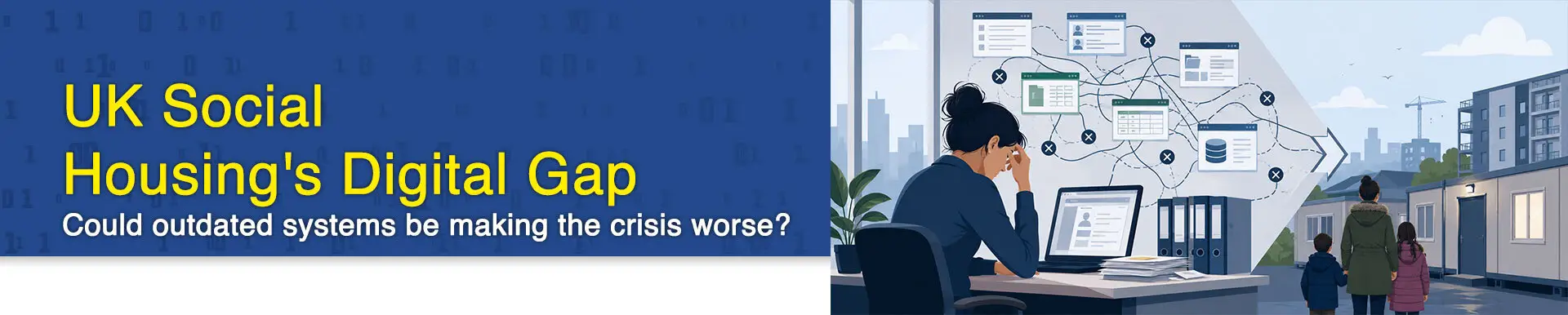
Ask a housing options officer how many systems touch a single temporary accommodation case, and the honest answer is usually “more than it should be.” Housing registers, allocations, homelessness casework, revenues and benefits, repairs and void management, and safeguarding records are frequently held in separate platforms, some cloud-based, some still spreadsheet-driven, many not built to talk to each other at all. A household can exist as five different records across five different systems, updated by five different teams, none of whom can see the full picture at once.
That fragmentation isn’t just an inconvenience. It’s a genuine barrier to meeting statutory duties under the Housing Act 1996 and the Homelessness Reduction Act 2017, which set firm deadlines for prevention and relief activity. When a caseworker has to manually chase updates across disconnected systems to establish where a household actually stands, deadlines slip, not through carelessness, but because the technology was never designed to give a single, current view of a case.
For councils now going through local government reorganisation, this problem compounds rather than resolves. A newly merged authority can inherit two or three parallel sets of local authority technology overnight, each with its own definition of a “case,” its own backlog, and its own way of recording the same statutory duty.
The subsidy gap is partly a data problem
The financial gap councils face on temporary accommodation isn’t only a policy and funding issue, it’s also, in part, a data visibility issue. Claiming the correct housing benefit subsidy for every night of every placement depends on accurate, real-time information moving between housing and revenues and benefits software. When those systems are disconnected, placements get logged late, rates get miscalculated, and legitimate reimbursement goes unclaimed simply because nobody had a single, reliable source of truth to work from. Councils that have unified this data have a materially better chance of recovering what they’re actually owed, rather than absorbing the shortfall into already-stretched reserves.
The human cost of disconnected casework
It’s worth being direct about what fragmented systems mean in practice, because it isn’t abstract. The Local Government and Social Care Ombudsman continues to uphold complaints in which a homelessness decision took years, not weeks, to resolve because of administrative failure, cases that speak less to poor intentions among housing teams and more to processes and systems that were never designed to track a case reliably from first contact through to a resolution. Every manual handoff between an intake form, a spreadsheet, and a case management system is a place where a vulnerable household can fall through a gap that a connected self-service CRM would have closed automatically.
This is also where a genuinely secure, well-governed platform matters as much as a connected one. Housing and homelessness casework involves some of the most sensitive personal data a council holds, safeguarding concerns, financial hardship, domestic circumstances, and scattered spreadsheets circulated by email are a considerably weaker fit for UK GDPR obligations than a single, access-controlled, cloud-based system built for exactly this purpose.
What a connected social housing tech stack actually looks like
A genuinely joined-up approach doesn’t mean replacing everything overnight. It means a housing options team, a revenues and benefits team, and the wider services covering highways, housing and roads working from the same underlying case record, so that a change logged by one is instantly visible to the others. It means frontline officers carrying out home visits and needs assessments with mobile working solutions that update the central case file in real time, rather than writing notes up later from memory. And where residents apply for housing support or report a homelessness concern themselves, that council self-service portal needs to meet GOV.UK Design System conventions and WCAG accessibility standards as a baseline, not an afterthought, because the people using it are very often navigating that form at one of the most stressful moments of their lives.
None of this requires councils to build something bespoke from scratch. It requires choosing a genuine cloud-based council management system designed around a single resident record, rather than a collection of separate modules bolted together over successive council administrations, and being honest about the gap between what the current systems were built for and what’s actually being asked of them now.
A practical first step: Auditing your housing data
Before commissioning anything new, it’s worth mapping the problem properly. A short, honest audit tends to surface more than most teams expect:
- How many separate systems touch a single temporary accommodation case, from first contact to move-on?
- How quickly can a caseworker see up-to-date subsidy and benefit status for a household without contacting another team?
- Where does a resident have to re-enter information the council already holds, because two systems don’t share data?
- What happens to a case when the officer who opened it is on leave or leaves the team – is the full history visible to a colleague, or locked in someone’s inbox?
- Does the current self-service offer meet accessibility standards for residents applying at a point of genuine crisis?
The answers rarely point to one dramatic failure. They usually point to a dozen small, accumulated gaps, which, together, add real cost and real delay to a crisis that already has too much of both.
Getting ahead of the crisis starts with the systems behind it
Local government reorganisation, tightening budgets, and rising demand mean the pressure on social housing and homelessness services isn’t going away soon. Councils can’t fix the national housing shortage on their own, but this isn’t really a housing story in isolation, either. It’s part of the wider public sector digital transformation most councils are already navigating, and the teams handling the most vulnerable residents shouldn’t be the ones left working with the oldest tools. What councils can control is whether their own systems help caseworkers respond quickly and accurately, or quietly get in the way. This is precisely the gap MCS was built to close, bringing housing, revenues and benefits, and case management onto a single, secure, cloud-based platform so that no household’s case depends on which spreadsheet a particular officer happens to be using that day.
Curious how MCS can help your council move forward? Book a free demo and see the difference for yourself.