
95% of councils surveyed are using or exploring AI. Only 21% report cost savings.
In its 2025 State of the Sector: Artificial Intelligence survey, the Local Government Association (LGA) found that 95% of responding English councils were using or exploring AI. Yet only 36% reported realised staff productivity benefits, 33% reported service efficiencies and 21% reported cost savings.
The survey represents 104 responses from 317 councils (33%). The LGA cautions that it is a snapshot of those respondents, not a representative measure of every council in England. Even with that limitation, the results raise an important question: why is it easier to show that AI saves time than to show that it saves money?
The question matters. In September 2026, the LGA estimated a £7 billion council funding gap by 2028/29 and reported that one in five councils with social care responsibilities needed Exceptional Financial Support to set a balanced budget for 2026/27. Councils need improvements that are measurable, sustainable and affordable, not simply another technology pilot.
In short
- AI use is growing, but adoption and measurable financial benefit are not the same thing.
- Productivity gains, cost avoidance and cashable budget savings are different outcomes. Councils should record each separately.
- The LGA found that defining where AI adds value was a major barrier for councils using or procuring external AI suppliers.
- Connected systems can help AI complete routine work, but the business case must also account for service quality, human oversight and the full cost of delivery.
- Start with a specific council service journey and establish a baseline before a pilot.
Why are councils finding it hard to define the value of AI?
Among councils using or procuring external AI suppliers, the LGA identified three substantial challenges. These were challenges with specifying and evaluating solutions, not proof that any particular technology fails to deliver savings.
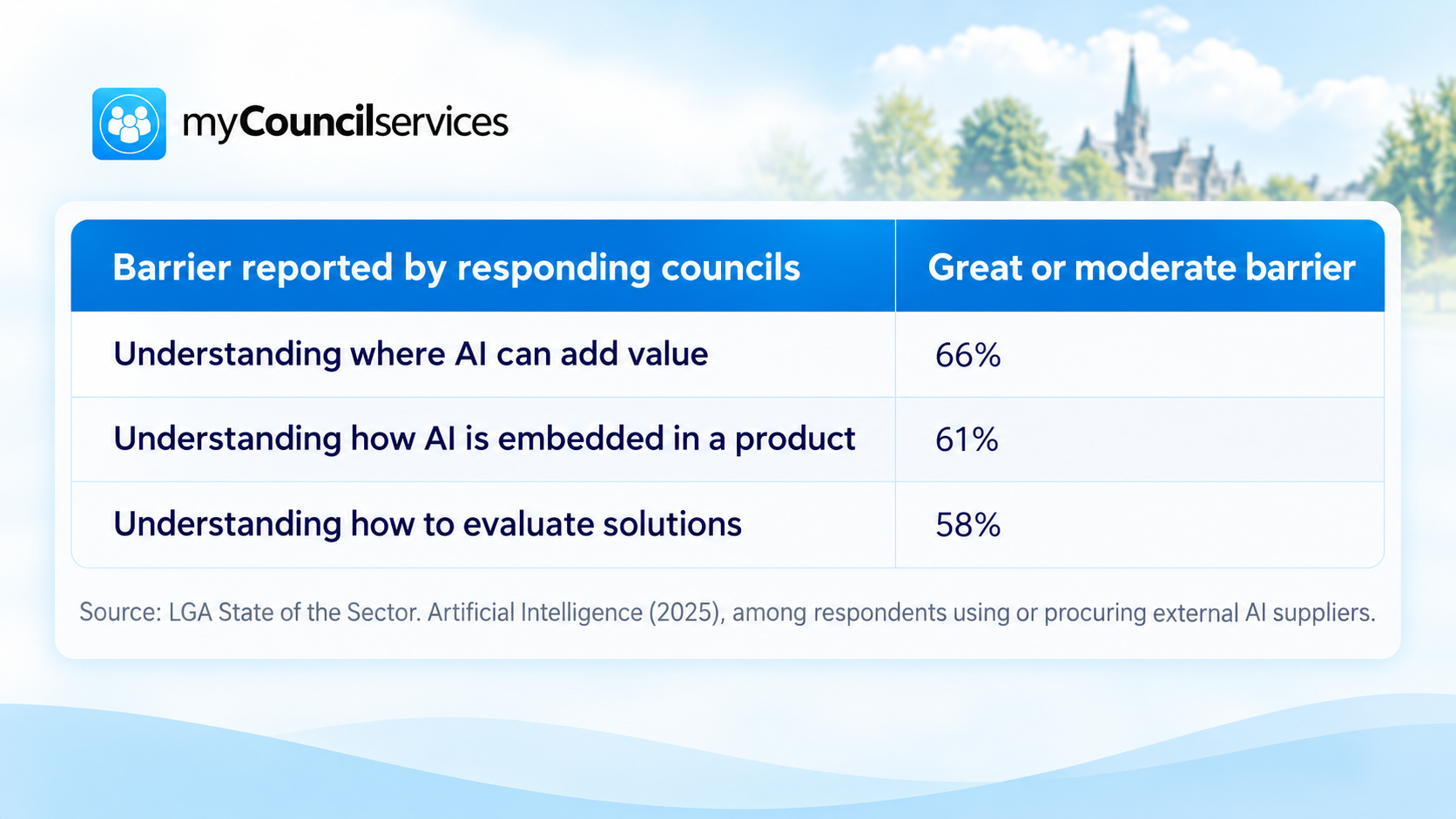
Across all respondents, the leading barriers were funding (62%), staff capabilities (56%) and staff capacity (52%). A well-defined scope will not solve all of these problems, but it makes it easier to assess a proposed investment and to spot a weak business case early.
This is consistent with the wider direction of the sector. Socitm describes AI as moving from experimentation into everyday public-service use, while emphasising governance, transparency and responsible scaling. MHCLG’s Local AI team is also focused on practical efficiencies, lower costs and better services, rather than technology for its own sake.
What is the difference between time saved and money saved?
An AI assistant that helps an officer write a response more quickly can be useful. The officer has more time to deal with other work, but the council may still have the same staffing and operating costs. That is a productivity gain, not automatically a budget saving.
For an honest business case, it helps to separate three benefits:
- Productivity: staff complete tasks faster, reduce backlogs, or spend more time supporting residents.
- Cost avoidance: the council meets rising demand without the recruitment, overtime or additional spending that would otherwise have been needed.
- Cashable savings: expenditure actually falls, and the reduction can be traced to a budget line or verified financial measure.
Consider an illustrative service that removes 500 hours of administrative work each month. If staff use that time to clear cases faster, the benefit is productivity. If the council avoids planned temporary staffing, it may be cost avoidance. If agency invoices or overtime expenditure demonstrably fall, it may be a cashable saving. The same hours cannot simply be counted as all three.
Integration matters because it can remove steps from an entire process. But it is not a guarantee of savings: processes still need to be redesigned, exceptions handled and the costs of running AI taken into account.
Five conditions for AI to deliver measurable service benefits
For resident contact and routine transactions, these are five useful conditions to put into a council’s specification. They are practical design recommendations, not findings demonstrated by the LGA survey.
1. Use current service information
Residents ask about bin collections, missed collections, applications and appointments outside office hours. AI that has appropriately controlled access to current service information can give a more useful answer than a static website page. It should also recognise when a record may be out of date or unavailable, rather than guessing.
2. Verify identity when the task requires it
Not every question needs a login. Anyone should be able to find general opening hours or a published collection schedule. But where a request involves personal information, such as an account balance or case update, the council needs suitable identity checks and permissions before details are disclosed. Where the enquiry passes to an officer, the verified information should be available securely so the resident does not need to repeat the process unnecessarily.
3. Complete suitable transactions, with controls
There is a practical difference between an AI service that explains how to report a missed bin and one that can create the report in the council’s case management system. The second can remove manual re-keying and reduce avoidable follow-up, provided the process is properly designed.
That does not mean unrestricted write access or fully automated decisions. Councils should specify which actions can be completed automatically, which require approval and which must remain with a qualified officer. This is particularly important for services that affect residents’ rights, entitlements or welfare.
4. Design escalation and safeguarding from the start
An AI service should have clear limits. A routine waste enquiry is different from a safeguarding concern, a complex complaint or a resident in distress. The specification should define when to refer to a named team, how to offer human assistance and what information is recorded for audit. Trigger phrases can help, but cannot be the only safeguard: testing, monitoring and sensible escalation rules are essential.
The importance of good complaints handling is underlined by the Local Government and Social Care Ombudsman’s 2025–26 findings: adult social care complaints and enquiries rose by 22%, and 77% of the 904 cases investigated were upheld. The aim should be to make access and escalation more reliable, not to stop residents reaching a person.
5. Carry the context into the next step
If a conversation needs an officer or field team, the relevant enquiry details, case reference and actions already taken should follow it, subject to role-based access and data protection controls. Otherwise, the resident starts again and some of the time saved at the front of the process is lost. Connecting customer contact, CRM, case management and mobile working can make that handover more effective.
How do you build an AI business case that stands up to scrutiny?
Start with one or two high-volume, well-understood journeys, not an assumed percentage of the council’s entire contact workload. Before running a pilot, establish:
- Contact volumes by reason, channel and time period.
- Average handling time, repeat contact and avoidable follow-up for those journeys.
- The proportion of cases that can genuinely be resolved without human intervention.
- Current staffing, overtime and external-service costs associated with the work.
- Escalations, complaints, accessibility needs and service-quality measures.
Then set out what will change. How many enquiries might the AI resolve correctly? Which manual steps are removed? What happens to the officer time released? Which expenditure, if any, will actually reduce?
A credible financial case also includes implementation, integrations, software licences, ongoing monitoring, assurance, training, support and changes to working practices. Measure the net position, not just the gross hours that a pilot claims to save. Socitm’s guidance similarly emphasises funding the full AI lifecycle and checking outcomes against an agreed baseline.
Measure the result for the resident, not just the chatbot
The number of conversations that end without a human agent is not a reliable measure of success. A resident may abandon a conversation and then telephone the council. A successful automated exchange should solve the issue, record the outcome correctly and avoid unnecessary further contact.
Measures worth tracking include end-to-end resolution, repeat contact, correct routing, administrative steps removed, resident satisfaction, error rates, escalations and the actual financial outcome. Review those measures after deployment, as well as during a pilot.
For more on this operational approach, see our guide to connecting AI contact centres to back-office action. Our article on council digital transformation and AI also looks at preventing avoidable demand rather than simply processing more enquiries.
Where My Council Services fits
My Council Services (MCS) is a cloud-based platform used by more than 50 local authorities across the UK and Ireland. It brings together resident self-service, contact centre CRM, case management, workflows and services such as waste and environmental management, revenues and benefits, bookings and appointments, and mobile working. Its strength is the connection between the resident’s enquiry and the operational work required to resolve it.
MCS Enterprise AI is designed for local government, runs within the UK-hosted MCS Enterprise Platform and is managed end to end. It is intended to work with council services rather than operate as a disconnected, generic chatbot. Where relevant functions are configured, and the council has authorised the necessary access and workflows, that creates opportunities to use current case information, support staff, route enquiries and complete appropriate tasks within the same service environment.
The precise capabilities, integrations and degree of automation should be confirmed for each council and use case. No responsible supplier should suggest that every enquiry can be automated or that cost savings are guaranteed. The better starting point is to identify a specific service journey and establish what an integrated approach can realistically improve.
For resident-facing AI, councils should follow relevant GOV.UK service design principles and meet the accessibility and data-protection requirements that apply to the service. That includes meeting applicable WCAG 2.2 AA accessibility requirements, being clear about use of personal data, applying appropriate permissions and involving people in sensitive decisions.
Frequently asked questions
Does the LGA survey prove that AI is failing to save councils money?
No. It shows what a group of responding councils reported in 2025. The 21% figure covers reported cost-saving benefits; it does not tell us whether those savings were cashable, how large they were, or what caused them.
What is the difference between productivity and cashable savings?
Productivity means getting more or better work done with available resources. A cashable saving is a verified reduction in expenditure. Avoiding an otherwise necessary future cost is a separate, potentially valuable outcome.
Does AI have to connect to back-office systems to be useful?
No. Drafting, summarising and helping officers find information can create benefits without transaction-level integration. For customer-service journeys, however, integration may allow AI to resolve issues instead of simply referring people elsewhere.
How should councils handle complex or sensitive enquiries?
Define clear boundaries, appropriate identity checks, human review, and safe escalation routes. Test them with real service scenarios and monitor what happens after launch.
How should a council evidence AI savings?
Agree a baseline, measure completed outcomes, and compare actual expenditure and performance before and after deployment. Include the full cost of the technology and the changes needed to make it work.
Start with your own numbers
A useful first conversation is not about how convincing an AI demonstration looks. It is about your contact reason codes, the journeys that cause repeat work, and where a connected system could complete an appropriate task from start to finish.
We can start with one service journey, identify a realistic scope, and discuss how to measure the outcome. There is no procurement commitment.
Book a 30-minute discussion: https://www.mycouncilservices.com/demo/
Read next:
- Council online forms software: Moving beyond PDFs
- Council Committee Management Software for UK and Irish Local Authorities
- AI-powered mobile workforce & self-service kiosk solutions for local authorities
- The missing tech stack in UK social housing: Why legacy systems are fueling the accommodation crisis