

LGR: The digital strategy decision councils can’t get wrong
For the first time since this process began, most councils in England know exactly what they are about to become.
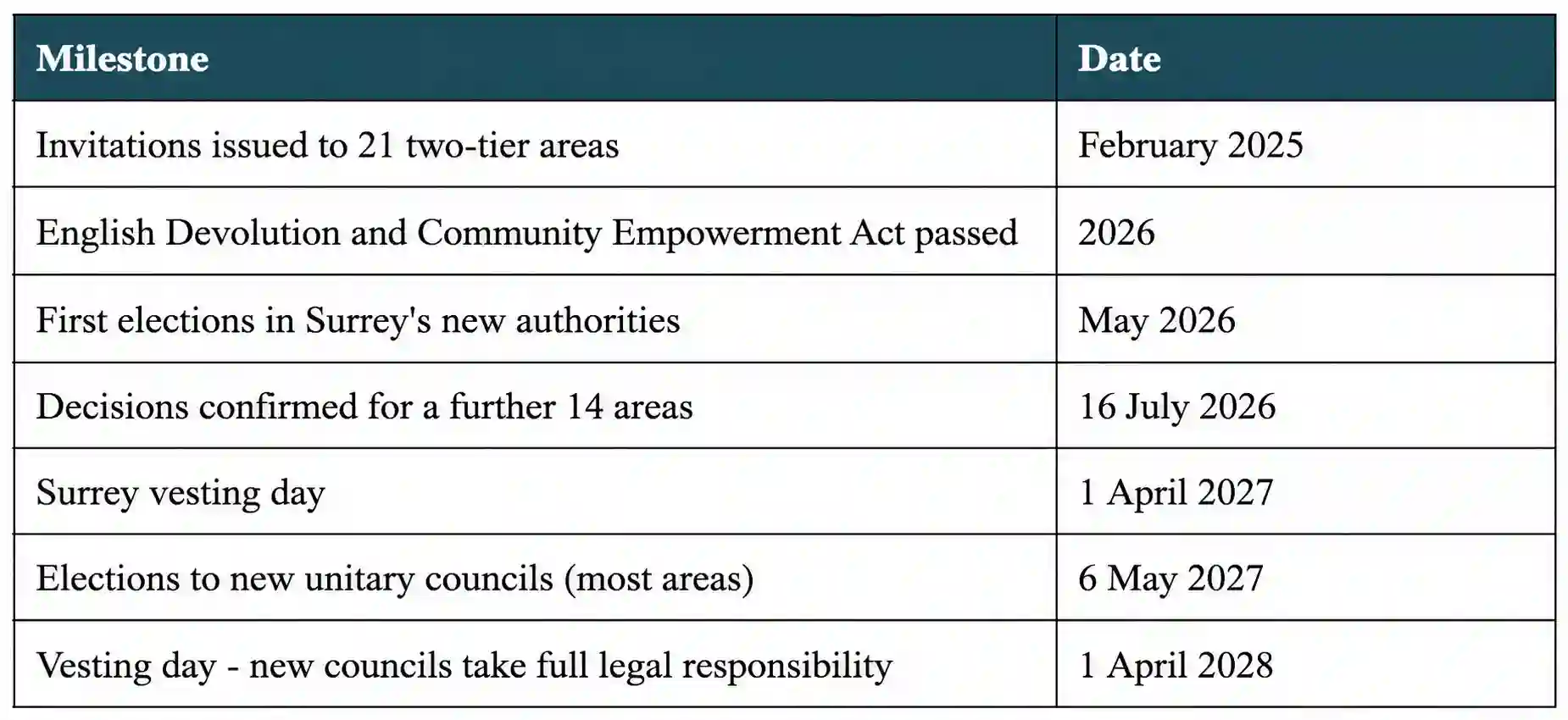
Decisions have now been announced for 19 of the 21 areas invited to reorganise, with the largest tranche, fourteen areas, from Kent and Medway to Lancashire, confirmed in a written ministerial statement on 16 July 2026. Elections to the new authorities fall on 6 May 2027. Vesting day, when the new councils take on full legal responsibility for services, is 1 April 2028.
Which means most reorganising authorities have roughly twenty months.
Twenty months to decide which revenues and benefits system survives. Which CRM the new authority runs on. What happens to two decades of quietly accumulated integrations that nobody fully documented and only one person really understands. For the authorities living through it, local government reorganisation has quietly become one of the biggest technology decisions of the decade, arguably a bigger determinant of how the new council actually works day to day than the structural reform itself.
Because here is the uncomfortable truth that rarely makes it into the business case: reorganisation does not just change who sits on which committee. It decides, almost by accident, which technology choices from three or four separate authorities survive into the new organisation, and which get carried forward simply because nobody had time to ask whether they should be.
Where local government reorganisation actually stands
Before the strategy, the calendar. A great deal of LGR commentary was written while the outcome was still speculative. It isn’t any more. The current position is set out in full in the House of Commons Library briefing on local government reorganisation and the LGA’s LGR hub, with the underlying powers contained in the English Devolution and Community Empowerment Act 2026.
The fourteen areas confirmed in July 2026, and the number of unitary councils each will have:
- Derbyshire and Derby – 2 · Devon, Plymouth and Torbay – 4 · East Sussex and Brighton & Hove – 2
- Gloucestershire – 1 · Hertfordshire – 4 · Kent and Medway – 4
- Lancashire, Blackpool and Blackburn with Darwen – 4 · Leicestershire, Leicester and Rutland – 2
- Lincolnshire, North and North East Lincolnshire – 4 · Nottinghamshire and Nottingham – 2
- Oxfordshire – 3 · Staffordshire and Stoke-on-Trent – 2 · Warwickshire – 2 · Worcestershire – 2
Two areas – West Sussex and Cambridgeshire and Peterborough- are still waiting, with the government stating that more time is needed to get those decisions right. We’ll come back to what that means for their technology teams, because it is a genuinely different problem.
What’s really at stake for your tech stack
When a county council and its districts become a single unitary authority, the legal and financial workstreams typically get months of dedicated transition planning. Technology, too often, gets a spreadsheet and a deadline.
That’s a problem, because every merging authority arrives with its own revenues and benefits software, its own council CRM, its own GIS and LLPG mapping, its own waste, licensing and regulatory systems, each procured separately, by separate teams, at separate points in the technology lifecycle. Somebody now has to decide which of these survives, which is retired, and which resident-facing services stay live throughout a merger residents never asked for and mostly won’t notice until their bin day changes or their council tax portal disappears without warning.
The instinct under pressure is to keep whichever system belongs to the largest legacy authority and quietly retire the rest. It’s the path of least resistance, and it’s usually the wrong call. A platform that served a district of 120,000 people perfectly well may simply not hold up when it is suddenly serving a unitary authority of half a million. In Hertfordshire, four new councils have to be carved out of eleven existing ones; in Gloucestershire, seven authorities converge into a single unitary. Neither of those is a scaling exercise you solve by picking a favourite.
Reorganisation isn’t really a question of which existing system wins. It’s a question of what the new authority actually needs, which is rarely identical to what any of its predecessors had.
Day one is not the finish line, and treating it as one is the mistake
The most useful reframing circulating in the sector at the moment is the idea of day one as a “minimum viable council”: on 1 April 2028, the new authority must be safe, legal and able to deliver statutory services. It does not have to be finished.
This distinction matters more than almost anything else in an LGR technology plan, because it determines what you attempt before vesting day and what you consciously defer. Council tax has to bill correctly on day one. Housing benefit has to pay. Safeguarding records have to be accessible to the people who need them, immediately, with a complete audit trail. Licences already issued have to remain valid and findable. Those are non-negotiable.
A single unified customer portal across four former districts, by contrast, is a genuine prize, but it is not a day one obligation, and authorities that try to deliver everything at once tend to end up doing the mandatory things badly. The stronger plans emerging from the reorganising areas separate the two explicitly: a hard “safe and legal” list that must land by vesting day, and a deliberate transformation roadmap for the eighteen months after it, with the platform chosen so that the second phase doesn’t require another migration.
That last point is where the real cost sits. Choosing a day one system purely because it is the quickest to stand up, without asking whether it can carry phase two, is how authorities end up running a second migration programme in 2030 that nobody budgeted for in 2026.
The hidden risk nobody puts on the reorganisation business case
There’s a second, quieter risk that rarely makes it into board papers: merging or sharing infrastructure at speed can multiply cyber exposure rather than reduce it.
Local authorities were already an attractive target before reorganisation entered the picture. Councils hold exactly the kind of sensitive resident data, housing, social care, benefits, safeguarding, that criminal groups look for, and legacy, loosely integrated systems make that data harder to defend consistently.
In December 2025, a cyber attack hit three London boroughs, Kensington and Chelsea, Westminster, and Hammersmith and Fulham, which shared access to IT systems owned by RBKC. Personal data belonging to thousands of residents was confirmed stolen, and services were disrupted across all three authorities. It was a stark demonstration of the structural point: when councils share infrastructure, whether through a formal partnership or through reorganisation, a weakness in one authority’s estate very quickly becomes everybody’s problem.
None of this is an argument against consolidation. It is an argument for doing it deliberately, with security designed in from the start rather than inherited as an afterthought from whichever legacy system happened to still be running when the deadline arrived. The Cyber Assessment Framework for local government is the obvious yardstick, and applying it to the target architecture, not just the systems you already have, is one of the highest-value things a transition team can do early, while the design is still on paper and changing it is free.
The reorganisation window you won’t get again
Here’s what makes this moment different from ordinary digital transformation work: councils rarely get budget, political mandate, and organisational appetite for change all pointed in the same direction at the same time. Reorganisation forces all three into alignment, whether leaders planned for it or not.
That makes this one of the best chances many authorities will get in a generation to move away from a patchwork of standalone systems and towards a genuinely integrated, cloud-based council management system, one built around a single view of the resident rather than a dozen disconnected logins.
It’s also the moment to get the fundamentals right rather than retrofitting them under pressure later. Services still need to follow the GOV.UK Design System and meet WCAG 2.2 accessibility standards, whatever the internal timeline looks like, and any new self-service CRM needs to be built with the Local Digital Declaration and the Service Standard in mind from the outset, not bolted on afterwards. Local Digital is also assembling a shared LGR playbook of guidance and case studies drawn from councils that have already unitarised, worth tracking, because the mistakes it documents are ones somebody has already paid for.
A modern self-service CRM, built to serve residents consistently across what might be three or four former council areas, does more than tidy up the org chart. Done well, it becomes the foundation that lets a newly formed authority actually behave like one organisation, rather than three former councils sharing a single logo. The same logic applies to GIS and LLPG mapping: reorganisation is precisely the moment to reconcile inconsistent address and property data across former boundaries, because doing that reconciliation later, once services are live and residents are relying on them, is far harder and far more disruptive.
Why this is also an AI readiness deadline
There’s a further layer that leadership teams are only just starting to grapple with. Central government has been actively encouraging councils to explore AI to ease pressure on stretched services, and analysis by the Tony Blair Institute put the potential efficiency gain at as much as £8 billion a year across local authorities.
Whatever the precise figure turns out to be, the direction of travel is clear, and it depends entirely on something reorganisation can either deliver or quietly sabotage: clean, consistent, well-governed data.
AI tools are only as useful as the data underneath them. A newly formed unitary authority that inherits three incompatible datasets, three different definitions of a “case”, and three sets of undocumented workarounds is not in a position to benefit from AI-assisted services any time soon, however confident the strategy document sounds. Councils that use the reorganisation window to properly consolidate and clean their data, including the mobile working solutions that keep frontline staff out of three different apps for one job, will be years ahead of those that migrate the mess and hope to tidy it up later.
The same discipline applies to back-office functions like revenues and benefits, where inconsistent case data across merging authorities causes some of the most disruptive migration problems of all. Adopting common data standards during the merge, rather than after it, is the difference between a data estate that is AI-ready by default and one that needs a second remediation programme nobody has budgeted for.
Five questions to ask before you migrate anything
Before committing to a system, a supplier or a migration timeline, it’s worth forcing every reorganisation decision through the same five questions:
- Which system genuinely serves residents best across the whole new footprint – not just the largest of the merging authorities?
- Where does running two systems in parallel for a few extra months actually cost less than migrating in a rush to hit an arbitrary date?
- What data absolutely cannot be lost, corrupted, or delayed in the move – revenue records, safeguarding cases, licensing history?
- Which existing supplier relationships were built around the old boundaries, and do they still make sense for the new one?
- Who has the authority to make the final call when three merging organisations each have a different preferred answer?
None of these have easy answers. But asking them properly, before the deadline forces a default decision, is the difference between a reorganisation that sets a council up for the next twenty years and one that spends the next five quietly working around problems everyone saw coming.
If you take only one of them into your next transition board, make it the last. Decision rights are the single most common point of failure in a merger of equals, and they are far easier to agree in 2026 than in the final quarter before vesting day, when every unresolved question becomes an escalation.
What if your area is one of the two still waiting?
For West Sussex, and for Cambridgeshire and Peterborough, the honest position is that the shape of the future authority is not yet settled, and that is a materially different planning problem, not simply a delayed version of the same one.
The temptation is to pause. The better response is to do the work that holds its value under any outcome. Data quality remediation is not wasted, whichever way the boundaries fall. Neither is documenting your integrations, mapping which systems hold which statutory records, rationalising duplicate addresses in the LLPG, or completing a cyber assessment of what you already run. Contract renewals falling due before 2028 deserve particular scrutiny now; check break clauses, assignment and novation terms, and whether a three-year commitment signed in 2026 can transfer cleanly to an authority that does not yet legally exist.
Authorities that spend the waiting period getting their own house in order will start their transition from a considerably stronger position than those that spend it waiting for certainty that arrives too late to act on.
Getting reorganisation right starts with treating it as a digital decision
Local government reorganisation will happen to a council’s technology whether or not anyone plans for it. The only real choice leadership teams have is whether that happens deliberately, as a considered piece of local authority technology strategy, or by default, as whichever system happens to survive the chaos of a merger deadline.
With vesting day fixed at 1 April 2028 and elections in May 2027, the decisions that will define the next twenty years of a new authority’s operating model are being made right now, mostly by people who are simultaneously running business as usual for the council they currently work for. That is a difficult position to be in, and it is precisely why the questions above are worth asking early, while there is still room to change the answer.
It isn’t about replacing everything overnight. It’s about making sure that whatever comes out the other side of reorganisation was actually chosen, not just inherited.
Build your transition strategy with our Local Government team
We’ve turned the questions above into a practical working document for transition teams. It covers the safe-and-legal list that has to land by day one, the data quality work that holds its value whichever way decisions fall, the contract clauses worth checking before 2028, and the cyber questions to ask of your target architecture rather than just your current estate. It’s built to be taken into a transition board meeting, not read once and filed.
If you’d rather talk it through, our team works with reorganising and newly formed authorities on exactly this, bringing revenues and benefits, CRM, GIS and LLPG, licensing, waste and frontline mobile working onto a single, secure, cloud-based platform without residents noticing the join. We’re happy to pressure-test a target architecture, review a migration plan, or work through the five questions against your own systems, with no expectation of anything beyond the conversation.
Frequently asked questions
When do the new unitary councils actually take over?
For most reorganising areas, vesting day is 1 April 2028, with elections to the new authorities on 6 May 2027. Surrey is ahead of the rest, with a vesting day of 1 April 2027 following elections in May 2026.
What happens to a council’s IT systems during local government reorganisation?
There is no automatic answer. Each merging authority brings its own revenues, CRM, GIS, waste and licensing systems, and the new authority must decide which are adopted, which are retired and which are replaced. Systems holding statutory records, council tax, benefits, safeguarding, licensing, need to be safe, legal, and operational from day one; wider transformation can follow afterwards.
What is a “minimum viable council”?
It’s the principle that on vesting day the new authority must be safe, legal, and able to deliver statutory services, but does not have to have completed every planned improvement. It helps transition teams separate what must land by 1 April 2028 from what can be sequenced deliberately in the months after.
Which areas are still awaiting a decision?
As of August 2026, West Sussex and Cambridgeshire and Peterborough are the two areas where government has said further time is needed. Decisions have been announced for the other 19 of the 21 invited areas.
How does reorganisation affect a council’s AI plans?
Directly. AI depends on clean, consistent, well-governed data, and reorganisation is the point at which datasets from several authorities are either properly reconciled or merged as-is. Authorities that consolidate and standardise during the merge are positioned to adopt AI far sooner than those that migrate the mess intact.
How long should an LGR technology migration take?
Longer than most transition timetables assume. The practical constraint is rarely the technology itself but data cleansing, reconciling business rules between authorities, and testing statutory processes end to end. Working backwards from 1 April 2028, most authorities need decisions on core platforms during 2026 to leave adequate time for migration and parallel running.