
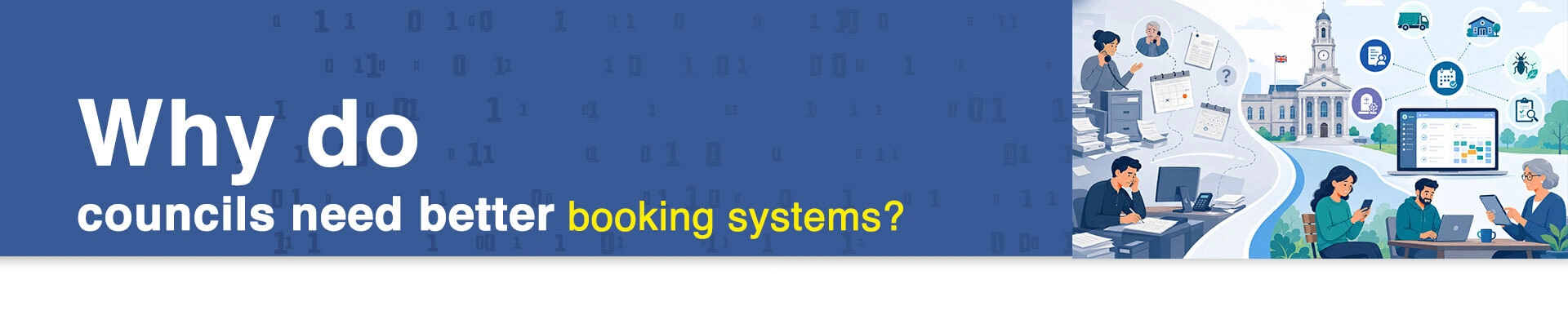
Council Booking System Software: How UK local authorities can reduce demand, improve access and deliver better resident services
A resident wants to book a bulky waste collection, arrange a registrar appointment, reserve a community hall or schedule a pest control visit.
In too many councils, that journey still starts with a search through the website, a phone call during office hours, a queue, a manual availability check, a separate payment and a confirmation that depends on another team updating another system.
For residents, it feels slow and inconsistent.
For staff, it creates avoidable administration.
For leaders, it creates cost, poor visibility and unnecessary pressure on already stretched services.
Council booking system software should no longer be seen as a digital diary. Used properly, it becomes part of the council’s core service infrastructure: one place to book, pay, notify, allocate, manage, report and improve.
For UK local authorities under financial, operational and public expectation pressure, that matters. Bookings are one of the clearest opportunities to remove friction from high-volume services while improving the experience residents receive.
The problem is not just booking. It is fragmented service delivery.
Most councils do not have one booking problem. They have many small booking problems spread across departments.
Waste services may manage bulky collections one way. Registrars may use another system for appointments. Bereavement services may rely on a separate diary. Leisure and community assets may run through inboxes, forms or spreadsheets. Environmental health may still require officers to manually allocate visits after a resident has already made contact.
Each workaround may function locally, but together they create a fragmented operating model.
A resident may need to understand which department owns which service.
A contact centre agent may need to re-key information into another system.
A payment may need to be reconciled manually.
A service manager may have limited data on demand, no-shows or capacity.
A senior leader may struggle to see where avoidable contact is being generated.
That is where the cost sits. Not only in the appointment itself, but in the duplicated handling around it.
A better booking journey looks different
Take a bulky waste collection.
In a manual model, a resident phones the council, waits for an agent, describes the items, checks availability, makes or arranges payment, receives a confirmation, and waits for the request to be passed to the waste team. If they need to change the date, much of the process starts again.
In a modern digital model, the resident selects the service online, enters the required information, sees available slots, pays in the same journey, receives confirmation and reminders, and the booking automatically becomes visible to the relevant operational team.
The same principle applies to registrar appointments, pest control visits, sports pitch bookings, cemetery appointments, community halls, inspections, allotments and licensing appointments.
The resident gets a clearer journey.
The council gets cleaner data.
Staff spend less time on routine administration.
Managers get a better view of demand and capacity.
That is the value of a joined-up booking platform.
What residents now expect
Residents do not compare council booking journeys only with other councils. They compare them with every digital service they use in daily life.
They can book healthcare appointments, arrange deliveries, reserve tables, change travel bookings and receive instant confirmations. They expect the same basic clarity from local public services.
That does not mean council services should copy the private sector. Local government has different duties, risks and accountability. But residents still expect services to be understandable, available outside office hours and reliable on mobile devices.
A resident should be able to:
- find the right service quickly
- see live availability
- book from a phone, tablet or desktop
- pay securely where payment is required
- receive confirmation by email or SMS
- reschedule or cancel where policy allows
- understand eligibility, documents, costs and next steps
- get support if they cannot use the online route
That is not a luxury. It is now the baseline for a modern public service.
Where MCS fits
My Council Services, or MCS, helps councils treat bookings as part of the wider service journey, not as a standalone transaction.
Instead of running separate booking processes across different teams, MCS gives local authorities a configurable platform for managing resident requests, appointments, payments, notifications, officer tasks, service rules and reporting in one place.
That matters because a council booking rarely ends when a resident chooses a slot. A booking may need:
- eligibility checks
- payment
- document capture
- officer allocation
- crew scheduling
- cancellation rules
- reminders
- visit notes
- completion updates
- management reporting
- service-level monitoring
MCS connects the resident-facing journey with the operational workflow behind it.
A bulky waste booking can move from online request to payment, collection slot, crew allocation and completion record.
A registrar appointment can be managed with controlled availability, required information, reminders and staff-side visibility.
A community facility booking can include availability, pricing, usage rules, payment, confirmation and reporting.
A pest control visit can move from request to appointment, officer allocation, visit record and follow-up action.
That is the difference between digitising a form and improving a service.
Payments and notifications should be part of the same journey
Many council bookings involve a payment, a reminder or both. When these sit outside the booking process, the service becomes harder for residents and more expensive for councils to operate.
A resident should not need to book in one system, pay through another route and wait for a manual confirmation. Staff should not need to reconcile payments, update spreadsheets or chase missing information.
A strong council booking platform should support integration with trusted public sector services such as GOV.UK Pay and GOV.UK Notify where appropriate. GOV.UK Pay is designed to help public sector organisations, including local authorities, take payments quickly and securely. GOV.UK Notify supports emails, text messages and letters for public sector organisations, including local authorities and the NHS.
For booking journeys, this creates a cleaner operating model:
Book the service.
Pay if needed.
Receive confirmation.
Get a reminder.
Attend the appointment or receive the collection.
Receive an update when the service is complete.
That simplicity benefits residents and staff.
The data case: better visibility, better decisions
Manual booking processes hide useful information. A spreadsheet may show what is booked this week, but it rarely gives leadership teams a reliable view of demand, capacity, channel shift or failure demand.
A modern booking platform should help councils answer questions such as:
- Which services generate the most avoidable contact?
- Which appointment types have the highest no-show rates?
- Which days, times or locations are most in demand?
- Where are residents abandoning the online journey?
- Which services could move from phone-led to self-service?
- Which teams need more capacity at peak times?
- Which assets are underused?
- Which paid services have incomplete or failed payment journeys?
This matters because councils are making difficult decisions about budgets, staffing and service levels. Better data does not remove those pressures, but it makes decisions more evidence-led.
It also helps councils move from reactive administration to proactive service management.
How AI can make MCS booking journeys better
AI should not be used in local government because it sounds innovative. It should be used where it makes services clearer, faster, safer or more efficient.
In MCS, AI can support the booking process in practical ways that reduce avoidable work and improve the resident journey.
1. Smarter triage
Residents often describe what they need in their own words. They may not know whether their issue belongs to waste, environmental health, highways, licensing or another service area.
AI-assisted triage can help interpret the request and guide the resident to the right booking route before they submit. This reduces misdirected bookings, duplicate requests and avoidable follow-up calls.
For example, a resident describing pests, dumped items, missed collections or tree issues can be guided toward the correct service category with clearer next steps.
2. Better slot recommendations
AI can support slot recommendations based on availability, location, resource constraints, service rules and previous demand patterns.
For mobile teams, inspections, environmental health visits, waste collections or home appointments, better slot allocation can reduce travel time, improve route planning and make better use of staff capacity.
This is where AI moves from theory to operational value.
3. Fewer failed bookings and no-shows
AI can help identify patterns linked to missed appointments, incomplete forms or abandoned booking journeys.
If residents regularly fail to complete a particular step, the wording, question order or supporting guidance can be improved. If certain appointment types have high no-show rates, reminder timing or channel choice can be adjusted.
For registrars, inspections, paid appointments and scarce officer capacity, reducing no-shows has a direct service benefit.
4. Demand forecasting
AI can help councils understand likely demand patterns across services.
Garden waste, bulky waste, pest control, event bookings, registrar services, cemetery appointments and inspections may all experience seasonal or localised peaks. Forecasting can help managers open additional slots, adjust staff allocation, plan communications or prepare for pressure before it arrives.
This supports better capacity planning and fewer last-minute operational decisions.
5. Officer support
AI can help officers by summarising booking histories, flagging missing information, identifying possible duplicates and highlighting cases that may need human review.
This does not replace professional judgement. It gives staff better information at the point they need to act.
For councils, that is the right use of AI: supporting officers, reducing repetitive checking and improving consistency.
6. Resident guidance
AI-powered help can support residents during the booking journey by answering common questions: what documents to bring, what items can be collected, what the fee covers, how to change a booking or what happens next.
Used carefully, this can reduce unnecessary calls and help more residents complete the task first time.
Responsible AI is essential in council services
AI in local government must be governed properly. Councils need to know where AI is used, what data it relies on, how outputs are checked and where human oversight remains necessary.
The UK Government’s AI Playbook focuses on safe, effective and responsible AI adoption in the public sector. The Data and AI Ethics Framework supports ethical decision-making across data and AI projects. The Algorithmic Transparency Recording Standard helps public sector organisations publish information about algorithmic tools they use and why they use them.
For councils, the principle is clear: AI should support better public services without hiding accountability.
Any AI capability within a council platform should be:
- transparent
- explainable
- auditable
- fair
- secure
- proportionate
- compliant with UK GDPR
- subject to human oversight where decisions affect residents
The strongest AI use cases for MCS are not about automated decision-making in sensitive areas. They are about better routing, clearer guidance, smarter scheduling, demand forecasting and officer support.
That distinction matters. Responsible AI should make services easier to understand and easier to manage, not more opaque.
The leadership case: reduce avoidable demand and protect capacity
The case for council booking software is not only digital convenience. It is service resilience.
Councils are under sustained financial and workforce pressure. The Local Government Association has repeatedly warned that councils face significant funding gaps and rising demand for statutory services. In that context, every avoidable call, duplicate data entry task, failed payment, missed appointment, and manual reconciliation creates pressure that councils can ill afford.
A joined-up booking platform can help councils:
- reduce avoidable contact
- cut manual administration
- improve payment completion
- reduce no-shows
- improve resident satisfaction
- support channel shift
- improve management reporting
- make better use of officer and crew capacity
- standardise service quality across departments
- create a stronger foundation for future digital transformation
This is not about forcing every resident online. Assisted digital and alternative access routes remain essential. The aim is to make routine transactions easier for residents who can self-serve, so staff have more capacity for residents who need direct support.
That is a better model for both access and efficiency.
Services that can move onto a council booking platform
The best starting points are usually services that are high-volume, repeatable, rules-based or appointment-driven.
Common examples include:
- bulky waste collections
- garden waste subscriptions and collections
- registrar appointments for births, deaths, marriages and citizenship ceremonies
- pest control visits
- environmental health appointments
- sports pitches, halls and leisure facility hire
- community centre bookings
- allotments and community garden plots
- markets and street trading pitches
- bereavement services, cemetery appointments and crematorium slots
- planning and building control appointments
- licensing appointments
- inspections and officer visits
Councils do not need to transform every service at once. Starting with one or two high-volume services can create a visible early win, prove the operating model and build confidence across departments.
What councils should look for in booking software?
A council booking system must work for residents, officers, service managers, digital teams and senior leaders. Before choosing a platform, councils should assess whether it offers the following.
User-centred design
The service should be designed around real resident tasks, not internal departmental structures.
GOV.UK and GDS alignment
The platform should support clear content, accessible forms, familiar patterns, performance measurement and continuous improvement.
Accessibility by default
The service should support WCAG 2.2 level AA expectations and be tested with different devices, browsers and assistive technologies.
Configurable service rules
Councils should be able to change slots, prices, eligibility rules, forms, notifications and workflows without starting a major development project every time.
Integrated payments and notifications
Booking, payment, confirmation and reminders should operate as one journey.
Back-office workflow
Staff should be able to view, manage, allocate, update and report on bookings from the same system.
Mobile working
Field officers and crews should be able to access the information they need away from the office.
Reporting and insight
Managers should be able to see demand, capacity, no-shows, completion rates, payment status and service performance.
Security and privacy
The platform should support secure hosting, role-based access, audit trails and UK GDPR-aware data handling.
Responsible AI capability
AI should improve triage, forecasting, slot allocation, resident guidance and staff support, with transparency and human oversight built in.
Why MCS is a practical place to start
Booking transformation works best when it is specific enough to deliver quickly and broad enough to scale.
MCS supports that approach. Councils can begin with services where the pain is obvious: high call volumes, manual scheduling, missed payments, poor visibility or frequent resident frustration. Once the model is proven, the same platform can be extended to other services.
That is important because councils do not need another isolated system. They need a reusable service capability.
MCS brings together the elements that matter:
- resident self-service
- configurable booking journeys
- payments
- notifications
- staff workflows
- mobile working support
- reporting
- AI-assisted improvement
- service management across departments
The result is not just a better booking form. It is a better operating model for routine council services.
Closing: from booking software to better local service delivery
A good booking system is one of the clearest signs that a council is serious about modern service delivery.
Residents benefit from faster access, clearer availability, simpler payments and better updates. Staff benefit from fewer manual tasks, cleaner workflows and better information. Leaders benefit from stronger data, improved capacity planning and a more consistent approach across departments.
For local authorities, bookings are a sensible place to start because they are visible, high-volume and directly linked to resident satisfaction.
MCS gives councils a practical way to modernise bookings without creating unnecessary complexity. It connects bookings, payments, notifications, workflows, reporting and AI-assisted improvement in one joined-up platform.
If your council is still managing appointments, collections, facilities or inspections through disconnected systems, now is the time to review where avoidable contact is being created and where residents are being made to work too hard.
Book a demo of MCS to see how your council can simplify bookings, reduce manual administration and deliver a better resident experience across multiple services.
Must read: